


Apparently more than one might think! In a recent Washington Post article, I read about some research done by an avian ecologist at the Illinois Natural History Survey. The researcher, Jeffrey Hoover, noticed that female cowbirds leave their eggs in the nests of other birds. These eggs and, eventually, the hatchlings were taken care of by the “host” birds.
Out of curiosity, the researchers removed some cowbird eggs from the nests of the other birds. Strangely, these nests were subsequently destroyed. Come to find out, the female cowbirds were keeping an eye on the nests where they placed their eggs and, if anything happened to them, they would destroy the nest in retaliation. The “host” birds raised the “foreign” hatchlings because this ensured some of their own chicks would survive – otherwise, “mobster” cowbirds killed all the chicks.
Frans de Waal, a primatologist at Emory University, says that the difference between humans and cowbirds is that the cowbirds aren’t thinking through their nest-trashing strategy. Gangsters like Laurence Fishburne as “Bumpy Johnson” in the movie Hoodlum certainly do: “You've been warned. Get ready for your final thrill. It's curtains, Dutch. The jig is up.”
It’s hard to know whether cowbirds think “the jig is up” before they destroy the nest of another bird or not. Nevertheless, this is an interesting example of how human behavior is not fundamentally different from animal behavior. In fact, De Waal argues that much of human behavior may have been hard-wired into us through evolution. That some behavior is “built-in” helps to explain how certain “intuitive” (and not necessarily effective) behaviors like tit-for-tat are used the world over and influence many aspects of social interaction and perception. If, as some behavioral researchers now think, we’re hard-wired to use intuitive (and potentially inefficient) strategies like tit-for-tat, we need to make an extra effort to get beyond our constraints and pursue more effective ways to interact – something relevant to thinking about negotiating.
Ashley Thornton
References
Vedantam, Shankar. “Behavior May Suggest We’re Not Only Human.” Washington Post, March 19, 2007, via Washington Post online, http://www.washingtonpost.com/.
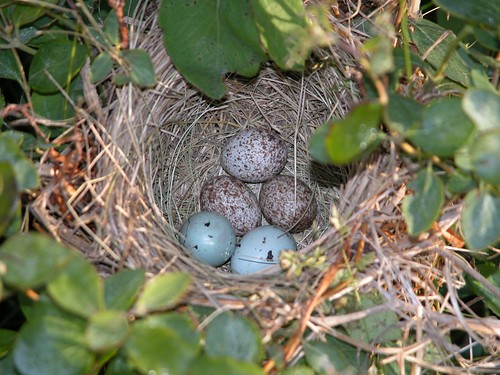
Photos by Pete Baer show three speckled cowbird eggs in the nest of a red-winged blackbird and the same nest after the blackbird eggs were pushed out. Retrieved from www.flickr.com.
Wednesday, 21 March 2007
What do gangsters and cowbirds have in common?
Posted by Disarmament Insight at 17:31 0 comments
Labels: cowbirds, Frans de Waal, gangsters, intuitions, multilateral negotiations, retaliation, Thornton
Sunday, 11 March 2007
The West Wing
I argued in this blog's previous posting on 7 March that in multilateral negotiating situations, ‘nice but retaliatory’ strategies like Tit or Tat run into difficulty because it’s very difficult to discriminate against non-reciprocators (See "You scratch my back ...).
One reason for this is that groups are much more prone to defectors and free riders the larger they become. It’s hard to identify those we should retaliate against. A recurrent theme in The West Wing, an American television series about the life of a fictional U.S. President, is the difficulty, not so much in retaliating militarily against terrorist attacks, but in identifying and locating the perpetrators without killing lots of blameless civilians. Israeli military forces encounter this problem each time they retaliate against attacks by the many Palestinian factions and splinter groups pitted against their occupation of the Gaza Strip and West Bank. In real life it’s hard to come up with strategies that strike the right balance between punishing defectors and maintaining effective cooperation. And it’s the problem in every multilateral negotiation in which some countries hitch their pet prerogatives to its coat tails, however marginal in relevance or unhelpful their riders prove to be.
The second problem is that multilateral negotiations aren’t iterative in the sense that, say, a game of Monopoly is, in which each player takes a consecutive turn repeatedly until the game is over. Negotiators almost always face uncertainty. They’re continually trying to assess not just their relationships, but the level and reasons for cooperation or defection between others at the same time. There are no neatly divided turns.
A third issue is that players aren’t equal in relative importance. Their defection or cooperation with us or, indeed, to each other, varies in significance. We may take a more (or less!) tolerant view of an ally defecting, for example, than of an adversary doing likewise. Moreover, how does one reliably tell between defections that are tactical (and perhaps stepping stones in the longer run to greater cooperation) from those that are profoundly bad for our interests?
It’s easy to see how misperception and errors can occur among negotiators, even if we set aside political will or a negotiation’s substance. The irony is that, at the same time, the rational intellectual difficulties created by uncertainty inherent in multilateral negotiations make the prospect of falling back on intuition more attractive. But intuitions may just compound matters if, say, you listen to your gut instinct to punish another negotiator or delegation and you’ve misread the situation.
All of this sounds difficult to overcome – and it is. It highlights the skill and experience necessary to negotiate effectively in multilateral situations. In other words, it’s what diplomats, the supposed experts in navigating this headache-inducing environment, are for.
John Borrie
Posted by Disarmament Insight at 11:12 0 comments
Labels: Borrie, cooperation, defection, multilateral negotiations, retaliation, uncertainty, West Wing
