

 About three months ago, I wrote on this blog about 'the pros and cons of precedent.' As a case-study, I referred to efforts by UN Member States to re-shape the upcoming third Biennial Meeting of States (July 14-18) to consider implementation of the UN Programme of Action to Prevent, Combat and Eradicate the Illicit Trade in Small Arms and Light Weapons in All Its Aspects.
The previous two biennial meetings - in 2003 and 2005 - had not been too successful in monitoring implementation of the Programme of Action. This in turn contributed to the failure of the 2006 Review Conference to assess the overall impact of the agreement and to sketch a plan for its strengthened future implementation.
In response to all of this, the Chair of the third biennial meeting - the Ambassador of Lithuania to the UN in New York - made some very sensible suggestions about how to make this next meeting more effective. He proposed focusing on a small number of issues on which there was already a good deal of international consensus (with a special focus on international cooperation and assistance and national capacity-building). He appointed facilitators on these issues, who then produced useful discussion-papers to prepare the debate. And he insisted that the meeting should aim to produce a consensus final report that would include recommendations on next steps and on a practical implementation agenda.
In my April 8 'precedent' post, I commented on how unusual it was to see such sensible proposals for change gain broad support given the almost reflexive attachment of disarmament diplomats to doing things as they have been done before. Now, however, although the Chair's proposals still seem to enjoy the support of the vast majority of UN Member States, cracks are beginning to appear in the new plan.
A small number of States - perhaps only two or three, but possibly more - are beginning to question the efficacy of the proposed new approach. The Chair is engaged in intensive bilateral diplomacy to see if he can address their concerns.
This presents a challenge to the international community; a test, if you like, of its resolve to deal seriously with the humanitarian impact caused by the illicit trade in, and misuse of, small arms and light weapons, which are used to take the lives of about 300,000 people every year and to cause untold misery to millions more.
Although they started out as such, efforts to deal with small arms and light weapons within the framework of the UN Programme of Action are, unfortunately, no longer based on consensus. Following the 2006 Review Conference, the United States cast the only vote in the UN General Assembly's First Committee against holding another biennial meeting of States this year.
When the third biennial meeting begins (without the U.S.) on July 14 at 10am (EST), diplomats may again be faced with the challenge of what to do if a small number of States refuse to play by the new rules that are being proposed. The choice, at least, would seem to be a simple one: Give in to pressure from a small minority of States and revert to an approach that has twice proven less than effective. Or, go with what the vast majority of States wants - an effective, focused meeting that stands a much better chance of advancing international efforts to curb the illicit small arms trade and of sketching out a much-needed agenda for future action.
Watch this space to see which way the cookie crumbles.
Patrick Mc Carthy
Photo Credit: "Demobilize child soldiers in the Central African Republic" by hdptcar on Flickr.
Friday, 4 July 2008
Testing the International Community's Resolve on Small Arms and Light Weapons
Thursday, 12 June 2008
Dealing with gun violence
Last week (June 2-8) was the official Global Week of Action against Gun Violence. Judging from the reports that have continued this week to arrive in my email inbox from the organisers of this initiative - the International Action Network on Small Arms (IANSA) - it would seem that this year has seen the most global activity by civil society to raise awareness of the problem of gun violence since IANSA launched the 'week of action' idea in 2003. Details of all of the activities that have taken place worldwide can be found here.
In the same vein, I also gave a talk earlier this week to participants in the Geneva Centre for Security Policy's course on 'New Issues in Security' on the topic of 'dealing with small arms and light weapons.' Preparing for this allowed me to reflect on the various ways in which the international community has tried to respond to the global scourge of gun violence since the issue first emerged on the international agenda in the mid-1990s.
A lot has certainly been achieved. In 2001, States party to the UN Convention against Transnational Organised Crime agreed a protocol to that convention to combat "the Illicit Manufacturing of and Trafficking in Firearms, their Parts and Components and Ammunition." This is still the only global, legally-binding instrument on guns in existence today. As important as it is, the protocol is essentially a crime control measure, however, and does not regulate State-to-State transfers of firearms nor, indeed, any other transfer of firearms authorised by a State.
Also in 2001, all UN Member States adopted the UN Programme of Action to Prevent, Combat and Eradicate the Illicit Trade in Small Arms and Light Weapons in All Its Aspects. Although it is not a legally-binding agreement, it does commit States to a broad range of actions at the national, regional and global levels that, if properly implemented, could make a real difference.
Some provisions in the UN Programme of Action have also been further developed. In 2005, UN Member States agreed an International Tracing Instrument that, if properly implemented, would allow them to identify the points at which small arms and light weapons cross the threshold from the legal into the illicit realm (this is crucial since most illicit guns start their lives as perfectly legal weapons). In 2007, a UN Expert Group issued useful recommendations to States on how to prevent small arms brokers within their jurisdictions from engaging in illicit brokering activities.
Outside of this framework, the Geneva Declaration on Armed Violence and Development - a stand-alone initiative coordinated by Switzerland and subscribed to by 94 States (and rising) - aims to achieve a measurable reduction in the global burden of armed violence, as well as tangible improvements in human security by 2015.
The United Nations has developed global standards for the disarmament, demobilisation and re-integration of former combatants in post-conflict situations and has plans to develop another set of global standards for a broad range of small arms control measures. The World Health Organisation is running a Global Campaign for Violence Prevention. Finally, ambitious efforts are underway with strong support from UN Member States to develop an Arms Trade Treaty that would regulate the global trade in all conventional weapons, including guns.
All of this is just what is happening at the global level (and this is not even an exhaustive list). A lot more is happening at the regional and sub-regional levels but outlining this would require a lot more space than is available to me here. It is at the national level, however, where action has been most disappointing. Implementation by States of their existing commitments, especially under the UN Programme of Action, has, generally speaking, been weak and uneven. (UN Member States will have an opportunity to review this situation and to do something about it when they meet next month for their third 'Biennial Meeting' to assess implementation of the UN Programme of Action.)
And yet, despite all of this activity, guns continue to flow into and around the illicit market, aided by shady brokers. They continue to find their way around UN arms embargoes. They continue to be transferred in an irresponsible manner. And, most importantly of all, they continue to be misused on a massive scale, leaving death, disability, displacement and destitution in their wake.
There are no simple, 'one-size-fits-all' policy solutions to the complicated problem of the proliferation and misuse of guns. A full three-quarters of the world's estimated 875 million firearms are thought to be in the hands of civilians. Two thirds of the 300,000 or so killings carried out each year using guns happen not in traditional 'armed conflict' situations, but in the context of criminality and inter-personal violence. And there is no simple link between the availability of guns and their misuse.
Despite having been on the international agenda for more than a decade now and despite a lot having been achieved during that time, we are still in the relatively early stages of really getting a grip on this problem. Focusing on the effects that guns have on people - as the global week of action does - is a useful way of setting priorities for the next decade of action on this issue.
Patrick Mc Carthy
Video credit: "Stop the bullets. Kill the gun." Film by Choice FM available on the IANSA Global Week of Action website.
Thursday, 5 June 2008
Ripples from Dublin
 It was a bit of an anti-climax coming back to Geneva following the historic breakthrough in Dublin last week that led to the adoption by 111 States of a new, legally-binding Convention on Cluster Munitions (CCM). (This will be opened for signature in Oslo in December and will enter into force as soon as 30 States have ratified it).
After the suspense, drama, emotions and celebrations of Dublin, getting back to ‘business as usual’ in Geneva has not been easy. Not that most Geneva-based disarmament diplomats have had any choice in the matter: On Monday morning it was straight into a week of meetings of the Standing Committees of the Anti-Personnel Mine Ban Convention. After two weeks of intense negotiations on cluster munitions, a further week of implementation discussions on landmines would not seem to me to be the ideal way to wind down. But the disarmament calendar has no mercy this year it seems.
The Conference on Disarmament (CD) also continues to plod along, trying - valiantly but with ever decreasing vigour it would seem - to break its now 11-year deadlock. Observing the CD's public plenary meeting on Tuesday morning was a rather surreal experience. The room looked strangely empty (probably due to the intersessional meetings of the Mine Ban Treaty going on at the same time down the street). Although this was the first CD meeting I’d managed to get to in over a month, the tone and tenor of the statements were much the same as the last ones I had heard. Nothing’s changed. The deadlock remains.
In the middle of proceedings, the Irish representative lobbed into this stagnant pool a report of what had happened in Dublin over the previous two weeks: A new treaty banning a whole class of conventional weapons; agreed in 18 months; setting a new norm and a new standard of international humanitarian law that will protect civilians and assist victims of these weapons. The contrast exposed by this statement could not have been starker, as was recognised by the CD's current President, the UK, who said that the success of the Dublin conference "flows directly from dissatisfaction at the existing international architecture for arms control and disarmament's ability to grapple with these issues" (see the 'Reaching Critical Will' CD report of June 3).
It will be interesting to see what ripple effects, if any, the Dublin negotiations will have on other areas of disarmament and arms control, including, but not limited to, the CD. Minds are already turned to this question. In its closing statement in Dublin, for example, Norway wondered how the lessons of the Oslo Process on cluster munitions could be applied to revitalising other areas of disarmament and arms control. Many others would like to know too, and this has, of course, been the focus of research by my Disarmament Insight colleagues at UNIDIR's Disarmament as Humanitarian Action project.
As foreshadowed in our last DI post, it will be particularly interesting to see the impact that the new Convention on Cluster Munitions will have on the remaining 5 weeks of negotiations that are scheduled to take place this year in the framework of the Convention on Certain Conventional Weapons (CCW). The CCW, as reported in previous posts, is negotiating a 'proposal' on cluster munitions intended to balance military with humanitarian concerns. Many of the States that have just adopted the new Convention banning cluster munitions are also party to the CCW. Some of the big users and producers of cluster munitions that did not participate in the Dublin negotiations - such as the US, China, Russia, India, Pakistan and Israel - are too.
This should create an interesting dynamic when the CCW meets again in July. States that were in Dublin could find themselves in the awkward position in the CCW of negotiating relatively weak provisions on cluster munitions when they have themselves already agreed to ban them. States that were not in Dublin might wonder why they are negotiating with other States that have already committed themselves to standards that are much higher than the CCW is every likely to achieve.
The question then is, does the CCW still have something to offer on cluster munitions? I think yes. The Dublin conference focused on the weapons themselves - particularly on their humanitarian impact - and banned them. The CCW, given its membership, will not achieve this and is not attempting to do so. However, the CCW could make a contribution by seeking to moderate the behaviour of States that possess cluster munitions but that have not (yet) agreed to ban them. This could include strongly urging these States never again to use cluster munitions and/or getting them to sign up to strict regulation of their (potential) use of cluster munitions in the future (although we know that any further use of these weapons will result in severe condemnation by the rest of the international community).
Any contribution that the CCW can make along these lines cannot, however, conceal the fact that almost three-fifths of UN Member States have already agreed to ban cluster munitions. The weapon is already well and truly stigmatized and it will be this that defines the debate from now on, rather than anything the CCW might be able to achieve in the time left to it this year.
As a colleague of mine asked me this week: What do you get when you take the CCW and turn it upside-down? The CCM!
Patrick Mc Carthy
Photo Credit: The Dublin Spire by IrishPics on Flickr.
Tuesday, 27 May 2008
Dublin: A spirit of compromise
 Having observed the Dublin Diplomatic Conference on cluster munitions from a distance during its first week, I finally arrived in Dublin over the weekend and observed its sixth full day of negotiations on Monday (a new convention prohibiting cluster munitions that cause unacceptable harm to civilians is due to be adopted this Friday).
As John Borrie’s posts below illustrate, during last week, negotiators made remarkable progress on some complex but less controversial issues on the table – including, notably, the issue of assisting victims of cluster sub-munition explosions, the draft article which is being hailed here as setting a new international standard in this area. Delegations also used last week, however, to stake out quite divergent positions on some of the more contentious issues that remain to be resolved here this week. These include (1) the definition of a cluster munition (that which is to be prohibited), (2) joint military operations and other forms of cooperation with States not party to the new Convention (the so-called “interoperability” issue), and (3) a transition-period after entry into force of the Convention during which States would still be allowed to stockpile and use cluster munitions.
Whereas States used last week to stake out their initial negotiating positions on these issues in fairly unequivocal terms, the tone of the debate on Monday was quite different, with many delegations indicating a willingness to compromise on issues on which, up to now, they had taken a relatively hard line. Complaints are still being voiced in private that not enough compromises are forthcoming from the ‘other side,’ but Monday’s debate in the Committee of the Whole gave a strong indication that States participating in the Dublin conference want a Convention by Friday and that they are willing to enter into the deals and compromises that will make this possible.
This will be no easy task given the deadlines faced by the conference. Although the new Convention must be ready for adoption by lunchtime Friday, in order to have enough time to translate and prepare the convention text, the final English version must be completed on Wednesday. Let’s take a brief look then, at how things are shaping up on the three issues mentioned above.
Joint military operations / Interoperability:
The textual proposal on interoperability prepared by Switzerland (as Friend of the President) foresees a new article and would leave article 1, which contains the convention’s prohibitions, unchanged. The new article would allow States party to the Convention to “host” States not party to it, meaning that the former would be allowed maintain bases, possibly containing cluster munitions, on the latter’s territory. It would also allow a State party to the Convention to engage in joint military operations with States not party to the Convention that uses cluster munitions “so long as a potential use [of cluster munitions] in a specific operation… is out of the effective control of the State party.”
Reactions to the proposal Monday divided into two camps; those delegations that saw no place in the Convention for such a provision and those that thought more work was needed on the proposal. Switzerland convened a further side-meeting on interoperability late Monday afternoon to work further on this.
Definition of a cluster munition:
New Zealand is taking the lead as Friend of the President on definitions. The proposed article 2 contains a straightforward enough definition of what a cluster muntion is, followed by a number of exclusions specifying what they are not. The first two sets of exclusions had so far been relatively uncontroversial since they cover such things as munitions that disperse flares, smoke, etc. or that produce electrical or electronic effects. The recent inclusion in the text, at the request of the UK, of an explicit exclusion for “air defence systems,” however, caused some confusion among other delegations Monday, despite assurances from the UK that such systems would be covered by the cumulative criteria contained in article 2 (c). A number of delegations pointed out that, if air defence systems were indeed covered by another part of article 2, then there was no need to mention them specifically.
“2 (c) or not 2 (c), that is the question” was how Sweden aptly characterised the crux of the debate on definitions. Article 2 (c) currently contains a set of 4 criteria, all of which would have to be met for a weapon to escape being defined as a cluster munition and, therefore, prohibited. These are (a) that the munition contain fewer than 10 sub-munitions, (b) that it can locate and engage a point target (i.e. sensor-fuzed sub-munitions), (c) that sub-munitions have an electronic self-destruct mechanism and (d) that sub-munitions have an electronic self-deactivating feature.
There is a formal proposal on the table to delete article 2 (c) from the draft Convention text but even among those States that have proposed this there is now a new spirit of flexibility that could envisage 2 (c) remaining as long as the so-called cumulative criteria are as tight as possible. Lebanon, one of the States that proposed deleting 2 (c), on Monday showed flexibility and a possible path to a compromise solution by proposing that a requirement to review, report on an evaluate the sufficiency of article 2 (c) be built into the Convention, an idea explicitly supported by Canada and Austria.
There were renewed expressions of support for including the weight of sub-munitions among the cumulative criteria. This proposal was introduced by Norway last week but did not make it into the current proposal by the Friend of the President. The proposal is to categorically prohibit all sub-munitions that weigh under 5 kg and to prohibit all sub-munitions that weigh between 5 and 20 kg if they are not sensor-fuzed and contain self-destruct and self-deactivation mechanisms. Sub-munitions that weigh over 20 kg would be allowed. Norway circulated an explanatory note on Monday that pointed out that this weight criteria would prohibit up to 99 percent of cluster munitions currently stockpiled and 100 percent of existing cluster munitions that have ever been used in war.
Transition Period:
Germany reported back on Monday on consultations it had been holding, at the request of the President, on the question of a transition period during which it would be possible for States party to the Convention to continue using cluster munitions. There is still a great deal of opposition to this idea and Germany did not have any breakthroughs to report from its discussions with other delegations. The conference President announced that he would now hold consultations on this issue.
This is just a taste of some of the main issues discussed on Monday during what was an intense set of discussions in the Committee of the Whole. Other important developments included the forwarding of two more articles to the plenary session that will take place later in the week – article 3 on storage and stockpile destruction and article 8 on facilitation and clarification of compliance - and side negotiations, led by Australia, to finalise the preamble.
Work is proceeding well and the atmosphere in the conference seems very constructive. Delegates are acutely aware, however, of the time pressures that they are now under, made even more pressing by the frequent reminders of the conference President, Ambassador Daithi O’Ceallaigh, that “there will be a Convention by Friday.”
Patrick Mc Carthy
Photo: US Senator Patrick Leahy (D-VT), left, speaking to a CMC briefing for delegates and media Monday on "The US and Cluster Munitions." The United States is not participating in the Dublin negotiations on cluster munitions. On the right is Lord Alfred Dubs of the UK. Photo by the author.
Thursday, 24 April 2008
All at sea on arms trade controls

The brouhaha surrounding the attempted Chinese arms shipment to Zimbabwe is likely to die down a bit now that China has said that it has recalled the vessel still fully loaded with its cargo of 70 metric tons of Chinese weaponry (apparently including small arms ammunition, rocket-propelled grenades, mortar rounds and mortar tubes). The cargo had been destined for landlocked Zimbabwe's armed forces but could not be offloaded in any of Zimbabwe's neighbouring countries due to vehement opposition from unions, churches, courts, civil rights groups and other governments in light of the post-election violence currently gripping Zimbabwe.
Before looking into what this episode can tell us about current international efforts to develop a treaty that would regulate the global arms trade (an Arms Trade Treaty), it is worth retelling this remarkable story (at least as it has been presented through news reports):
It seems that, sometime during 2007, the Zimbabwe Ministry of Defence ordered the weaponry from China, one of its biggest trading partners. An invoice was apparently sent on 21 January 2008 and the goods, manufactured by Poly Technologies Inc. - a Chinese State-owned arms company - left China on the Chinese State-owned cargo ship, the An Yue Jiang, around the middle of March, presumably after payment (US$1.25m) had been received.
On April 14, a Monday, while the ship was approaching the South African port of Durban, Noseweek, an investigative magazine in Cape Town, reportedly received a phonecall from a whistle-blower advising of the ship, its cargo and the destination of both. When the ship anchored off Durban a few days later, the South African Transport and Allied Workers Union refused to unload the weapons, citing fears that Robert Mugabe's government might use them to crack down on opponents in the disputed election, the results of which had not yet been released, despite almost a month passing since the polls.
On April 18, the Friday of the same week, it was reported that the Durban High Court suspended the ship's conveyance permit and ordered that it and its cargo should stay put. When an attempt was made to serve the court order on the captain of the An Yue Jiang (it seems that the order was actually on its way to the cargo ship on a small boat), the latter weighed anchor and sailed away with the captain apparently announcing on the radio, "next stop Maputo," referring to the capital of Mozambique. This, it seems, was a feint since instead of sailing the short distance north-east to Maputo, the ship headed instead in the opposite direction, around the Cape of Good Hope, apparently making for Angola.
But it was not to be. South Africa's main trade union confederation called on workers in other African countries not to unload the weapons bound for Zimbabwe. Other countries, including Zambia and the United States, weighed in to urge countries in the region not to allow the arms to be delivered. The United States also asked China to halt the delivery and recall the vessel. The ship did reportedly manage to dock in Luanda, Angola, where it was allowed to unload other cargo, but not the weapons destined for Zimbabwe. Finally, with no South African port willing to accept it, the An Yue Jiang was reported on April 24 to be turning back towards China.
What stands out for me about this story, and the reason it can shed some light on the challenges to be faced in developing an Arms Trade Treaty, are the views that have been expressed about the appropriateness of this particular arms sale, particularly by Zimbabwe and China. Both countries point out that the sale was initiated long before the current crisis in Zimbabwe developed and that Zimbabwe is not under an arms embargo. Zimbabwe's Deputy Information Minister, Bright Matonga, is reported as saying that:
"Every country has got a right to acquire arms... How they are used, when they are going to be used is none of anybody's business."The Chinese Foreign Ministry is reported as saying that:
"China has always had a prudent and responsible attitude towards arms sales, and one of the most important principles is not to interfere in the internal affairs of other countries."At the 2005 World Summit, all of the world's Heads of State and Government agreed, for the first time, that states have a primary responsibility to protect their own populations and that the international community has a responsibility to act when these governments fail to do so.
Moreover, the broadly supported UN General Assembly resolution that initiated the current international effort to develop an Arms Trade Treaty recognises that:
"...the absence of common international standards on the import, export and transfer of conventional arms is a contributory factor to conflict, the displacement of people, crime and terrorism, thereby undermining peace, reconciliation, safety, security, stability and sustainable development."
It is difficult to imagine how common international standards for the import, export and transfer of conventional arms could be developed without taking into account, inter alia, the internal situation of the recipient State.
The regional politics surrounding this episode are, of course, intricate; and certainly more complicated than media reports often capture. But it has certainly raised awareness about some of the issues at stake in moving towards common international standards in the arms trade. It also suggests that the process of developing an Arms Trade Treaty will not be an easy one. The saga of the An Yue Jian provides a valuable real-world case-study that should be of value to UN Member States as they grapple with ways of effectively regulating the global arms trade.
Patrick Mc Carthy
News reports used in compiling this post:
- South African union workers: we won't move weapons bound for Zimbabwe (The Associated Press, April 18)
- South African union refuses to unload Chinese arms destined for Zimbabwe (Reuters, April 18)
- Group says chip [sic] with arms for Zimbabwe leaves South Africa (The Associated Press, April 18)
- Zimbabwe weapons ship seeking port (The Associated Press, April 19)
- Zimbabwe arms ship seeks port (The Times South Africa, April 19)
- Zimbabwe arms shipped by China spark an uproar (IHT, April 19)
- Zimbabwe arms ship quits S Africa (BBC News, April 19)
- Unions step up campaign against boat with arms for Zimbabwe (The Associated Press, April 21)
- China says it may recall Zimbabwe arms shipment (IHT, April 22)
- China may take Zimbabwe are shipment back (The Associated Press, April 22)
- China defends Zimbabwe arms shipment headed for Angola (AFP, April 22)
- Zimbabwe's neighbours unite to block arms shipment (The Associated Press, April 22)
- China Foreign Ministry defends arms shipment to Zimbabwe, but indicates deal may be scrapped (The Associated Press, April 22).
- Ship Carrying Arms for Zimbabwe, Plays 'Cat and Mouse' with Monitors (Voice of America, April 23)
- Britain's PM calls for world arms embargo against Zimbabwe (The Associated Press, April 23)
- China says weapons for Zimbabwe may turn back (IHT, April 23)
- After unions, church groups unite, China says ship carrying arms to Zimbabwe likely to return (The Associated Press, April 23)
- Zimbabwe arms shipment returns to China (The Guardian, April 24)
- Church calls for Zimbabwe action (BBC News, April 24)
- Arms shipment meant for Zimbabwe to return to China (IHT, April 24)
- Mugabe Rival 'Clear Victor' - US (BBC News, April 24)
- Angola Allows Chinese Ship to Dock, but Not Unload Arms for Zimbabwe (New York Times, April 27)
Photo Credit: "Alone" by John Borrie
Tuesday, 8 April 2008
The Pros and Cons of Precedent
 Diplomats are often risk-averse in multilateral disarmament negotiations. When questions of national security are at stake, which is often the case, there is really no other choice but to be cautious. The consequences of being too ambitious or too trusting is that one's own State could be taken advantage of and so end up at a net security disadvantage.
One way of trying to maximise the chances that negotiations will follow a predictable path and not come off the rails before their reach their conclusion is to always do things the way they have been done in the past. While this is by no means a sure-fire recipe for success, relying on precedent does bring with it many advantages; not least a set of practices and standard operating procedures that are recognised and accepted by all parties to a negotiation.
But, as I wrote in volume 1 of the Disarmament as Humanitarian Action project series (Alternative Approaches in Multilateral Decision Making: Disarmament as Humanitarian Action; the burgundy volume on the left), precedent brings with it disadvantages as well as advantages:
...the concept of precedent comprises both a conservative and a creative element. Like a ratchet, it has two functions; to allow forward movement (innovation) while preventing backsliding. Unfortunately, much of today’s disarmament diplomacy overemphasizes the conservative element while underutilizing the creative element of precedent. As a result, the concept of precedent tends to constrain more than it enables multilateral disarmament negotiations and, on the whole, actually serves to stifle innovation. Although, thankfully, there are some notable exceptions, many disarmament diplomats have become too used to the idea that, “if it hasn’t been done before, then we can’t do it” (p. 61).
The stifling effect of precedent can sometimes be observed not only in negotiations but also in the processes through which the implementation of multilateral agreements are monitored and evaluated. Here again, the prevailing thinking is often more concerned with how things have been done in the past, regardless on how effective this has been, than with coming up with fresh new ideas that could prove to be more effective than what has gone before.
It’s refreshing, then, when one actually observes such fresh new ideas take hold and promise to make some improvements over past practice. Although it is early days yet, this seems now to be happening in the international process to monitor implementation of the UN Programme of Action to Prevent, Combat and Eradicate the Illicit Trade in Small Arms and Light Weapons in All its Aspects.
This multilateral process has been through some tough times. In 2003 and 2005, UN Member States convened so-called biennial meetings to monitor implementation of the agreement. Much of the value that such meetings could have had was whittled away by long, general statements by States and by an insistence on discussing all aspects of what is, by its very nature, a very broad framework of action at the national, regional and global levels. In 2006, the Programme of Action’s first Review Conference, which was meant to evaluate the impact that the agreement had had during its first five years of existence, ended without any agreement whatsoever on what that impact had been or on what the next steps should be.
It’s against this backdrop that the designated Chair of the 3rd biennial meeting of States, scheduled to take place in New York in July of this year, has taken some bold steps towards ensuring that this forthcoming meeting will be more effective that the ones before it. This entails (surprise surprise) proposing to do things differently than they have been done before; breaking with precedent in order to do things better. The innovations being proposed by Ambassador Dalius Cekuolis of Lithuania include:
-- The 2008 biennial meeting should focus on a limited number of issues on which there is already a good deal of common understanding and on which concrete progress can be made by the international community; namely (1) cooperation, assistance and capacity-building, (2) illicit brokering, (3) stockpile management and surplus disposal and (4) implementation of the international small arms tracing instrument.
-- Ambassador Cekuolis has appointed Colombia, Republic of Korea, Switzerland and Egypt, respectively, to prepare these substantive discussions and to facilitate them at the July meeting.
-- States are being asked not to deliver time-consuming national statements at the biennial meeting but to focus instead on the above issues and on identifying other priority issues that could be dealt with in-depth at future meetings; thus developing a longer-term implementation agenda for the Programme of Ation.
-- An attempt seems likely to be made to negotiate a substantive outcome document of the meeting that would go beyond the usual procedural description of who participated and how many sessions were held to make concrete recommendations for next steps that could be taken up subsequently by the UN General Assembly.
If these seem like sensible ways of helping to ensure a more productive meeting that will advance implementation of the Programme of Action on small arms, it is because they are. It is just a pity that is has taken so long for these reforms to be proposed.
The intoxicating power of precedent can sometimes blind us to fact that there are better, more effective ways of doing things.
Patrick Mc Carthy
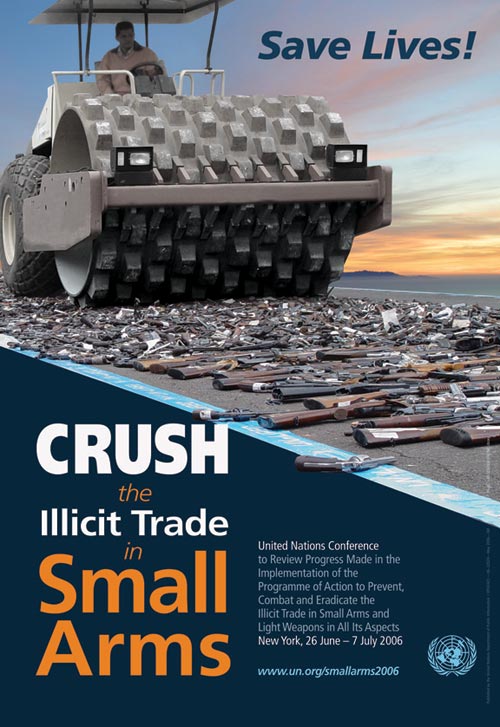
Photo Credit: United Nations; Poster for the 2006 Review Conference of the UN Programme of Action on the illicit trade in small arms and light weapons
Thursday, 13 March 2008
Worrying the Lords of War

On 30 August 2007, the UN Secretary-General submitted to the General Assembly a report of a Group of Governmental Experts on "enhancing international cooperation in preventing, combating and eradicating illicit brokering in small arms and light weapons." On 6 March 2008, Thai police arrested Viktor Bout, one of the world's most notorious gun-runners who had eluded capture for years. Coincidence? I think not.
If only it were possible to make such a connection without having ones tongue firmly in cheek, assessing the effectiveness of arms control agreements would be a much easier task. Unfortunately, Viktor Bout's arrest had nothing to do the UN expert group report - which, in any case, contains only recommendations on how States can close legal loopholes used by illegal arms dealers.
A March 10 editorial in the International Herald Tribune argued that Bout's arrest - or, rather, the length of time it has taken to put him behind bars - should serve as a "wake up call to governments and international organizations" and that it:
"illuminates the need for more enforceable legal strictures against the global arms trade and for more cooperation in enforcing those that already exist."Unfortunately, such strictures are in short supply at the global level. The idea of a multilateral, legally-binding Arms Trade Treaty is currently being considered by UN Member States but actual negotiations on it have yet to begin. The UN Programme of Action on the Illicit Trade in Small Arms and Light Weapons, which contains commitments to control brokering activities and exports, is not legally binding.
It is true that some individual States, although not many, have effective laws in place to regulate arms brokering activities. Shady arms brokers are global players, however. They are very good at arranging complicated deals from, in and through countries with the weakest regulation, or none at all. There will always be a weakest link in the chain of national regulations or arms brokers. Without effective global regulation of the arms trade, Viktor Bout's successors will have little difficulty moving into the void his arrest has created.
I've always thought that the most effective way of gauging the effectiveness of proposed or existing international agreements to regulate the arms trade would be ask illicit arms dealers how worried they are about them. Not a very practical idea, I realise. Such people normally do not like to discuss their work. However, now that Mr. Bout is behind bars and possibly looking for ways to pass the time, perhaps we should send someone to talk to him about the UN Programme of Action on the Illicit Trade in Small Arms and Light Weapons and the proposed Arms Trade Treaty. If he begins to look distinctly uncomfortable and breaks out in a cold sweat, we'll know we're on the right track. Given the rather anaemic regulation of the global arms trade that we have at the moment, however, I would predict a somewhat calmer reaction from Mr. Bout.
Patrick Mc Carthy
Photo Credit: Nicholas Cage playing Yuri Orlov, a character based on Viktor Bout, in a scene from the film, "Lord of War."
Thursday, 28 February 2008
Explaining Civil Society Schizophrenia
 Tuesday's post on 'civil society schizophrenia' seems to have struck a chord. Apart from some insightful comments, which you can read, I've also received a number of emails from NGOs telling me that they are as puzzled as I am at the different levels of formal integration of civil society into multilateral processes of disarmament and arms control; from the Nuclear Non-Proliferation Treaty to the Anti-Personnel Mine Ban Convention.
Some have suggested interesting explanations for this phenomenon. For example, Piers suggests that, although the diplomats dealing with all of these issues may generally be the same people, perhaps the NGOs are not. In other words, might not different levels of acceptability (to governments) of issue-specific NGOs explain the different levels of formal civil society integration across these issue-areas? Daniel Feakes points out, however, that the same NGOs that deal with biological weapons issues also tend to deal with chemical weapons issues but that the Chemical Weapons Convention (CWC) is decidedly more restrictive than the Biological Weapons Convention when it comes to granting formal roles to civil society.
An anonymous commentator on Tuesday's post suggested that NGOs are largely excluded from the NPT process because States with nuclear weapons consider them indispensable to their national security. While I would agree with this point as it relates to the NPT, this line of reasoning does not explain why civil society is largely excluded from the CWC process. States Parties to the CWC have renounced chemical weapons and yet NGOs still find it hard to gain access. Daniel Feakes did me the great service of suggesting where the CWC should appear in my Spectrum of Civil Society Integration, on which I now bestow the official acronym 'SCSI' (pronounced 'skuzzy'). The SCSI now looks like this (you should imagine these items stretched out on a single-line scale from left to right. As one moves along the scale from left to right, the level of formal integration of civil society increases):
Conference on Disarmament (CD) -- Nuclear Non-Proliferation Treaty (NPT) -- Chemical Weapons Convention (CWC) -- Biological Weapons Convention (BWC) -- UN Programme of Action on the Illict Trade in Small Arms and Light Weapons (PoA) -- Convention on Certain Convention Weapons (CCW) -- Oslo Process on cluster munitions -- Anti-Personnel Mine Ban Convention (Ottawa Convention)
Now that we have diagnosed civil society schizophrenia as a pandemic afflicting multilateral disarmament diplomats, how can we explain it? I do not think that one simple explanation will do justice to this phenomenon. Instead, I would propose the following set of four tentative explanations that, taken together, might give us a better understanding of what we are dealing with:
WMD vs. Conventional Weapons: A first-cut explanation derives from the blatantly obvious observation that weapons of mass destruction (WMD) are located at the left of the scale while conventional weapons are on the right. The Conference on Disarmament deals with non-WMD issues as well, of course, but three of its four current priorities are WMD-related - banning the production of fissile material for nuclear weapons, assuring non-nuclear weapon States that they will not be threatened or attacked with nuclear weapons, and nuclear disarmament. It is surely not a coincidence that the CD, NPT, CWC and BWC all appear next to one other on the left of the scale. Could it be that States 'trust' or see a role for civil society when it comes to conventional weapons issues, but not when it comes to WMD?
Potential vs. Actual Humanitarian Impact: The scale separates out, on the left, WMD with catastrophic potential humanitarian impacts from, on the right, conventional weapons with huge actual (and demonstrable) humanitarian impacts. We should of course never forget that nuclear, chemical and biological weapons have all been used in the past with devastating consequences. Chemical and biological weapons are banned, however, and nuclear weapons have not been used against humans since 1945. Guns, cluster munitions and mines, on the other hand, claim hundreds of thousands of human lives every year. They also maim, impoverish and condemn whole communities and regions to perpetual underdevelopment. Could it be that the more immediate and visible is the humanitarian impact of a weapons system, the easier it is for NGOs to integrate themselves into formal multilateral processes?
Old vs. New: It is interesting to note that, generally speaking, as one moves along the scale from left to right, the issues (or institutions) tend to become newer. The Conference on Disarmament can trace its origins back to the Ten-Nation Committee on Disarmament of the late 1950s. On the opposite end of the scale, negotiations on the Ottawa Convention were completed in 1997. The time scale does not hold for all issues - e.g. the CWC post-dates the BWC by two decades and the CCW is older than the PoA - but a general trend is recognisable. Could it be that the more recently a multilateral process on disarmament and arms control is institutionalised, the more likely it is for civil society to be well integrated?
Geneva vs. the Hague (vs. New York): In his comment on Tuesday's post, Daniel Feakes attributed the difference between civil society integration in the BWC and the CWC to "cultural" differences between Geneva and the Hague. He pointed out that, "in Geneva, despite the restrictiveness of the CD, diplomats are fairly used to interacting with NGOs and with NGOs being around in the Palais [UN building]. In The Hague, most diplomats are bilateralists rather than multilateralists and seem to be less used to having NGOs around." This, in my view, is a very important point. There are also cultural differences between Geneva and New York when it comes to the way in which multilateral disarmament processes are conducted (see our earlier posting on "Is there a Geneva / New York Divide?). Could it be that the place in which a multilateral disarmament process is created and maintained can influence the degree of integration of civil society?
This is just a first attempt to explain why we observe different levels of formal civil society integration across different issue-areas of multilateral disarmament and arms control. None of the above tentative explanations is satisfactory on its own but, taken together, they begin to make sense (at least to me).
Please do let me know, by using the comments function at the bottom of this post, if you can discern any other patterns from the SCSI tealeaves. With your help, we'll crack this one yet.
Patrick Mc Carthy
Photo Credit: 'Schizophrenia' by LILLAjija on Flickr.
Tuesday, 26 February 2008
Civil Society Schizophrenia

Reading John Borrie's daily postings from last week's Wellington conference on cluster munitions (see below), I was reminded of something that I have been mulling over in my mind for some time now but have not yet had the chance to examine properly. I am referring to a highly specific professional disorder that seems only to afflict disarmament diplomats. It's called 'civil society schizophrenia.'
Last week in Wellington, 122 States slogged it out with each other and with the now formidable Cluster Munitions Coalition of NGOs to agree a draft text that will serve as the basis for negotiations on a new Cluster Munitions Convention. NGOs were present in Wellington's Town Hall for the entire duration of the conference. They intervened at will in the discussions and openly criticized certain States for attempting to weaken the Wellington text. NGOs provided valuable inputs to the debates based on sound research, interpretation of evidence and testimony of victims. In short, civil society was an integral, dynamic and vital element of the Wellington conference that influenced the outcome of the meeting.
Compare this with what happens in the Conference on Disarmament, another negotiating forum that features regularly on this blog. One NGO - the Women's International League for Peace and Freedom - has one opportunity each year to address the Conference; on March 8, International Women's Day. But they may not do so themselves. They must pass their statement, drafted by a separate conference of women's NGOs from around the world, to an official of the Conference, invariably a man, to read out while they observe in frustration from the public gallery. This dismal situation has at least created some comic relief in the past, such as the occasion a few years ago when the (male) Deputy Secretary-General of the Conference began reading the statement with the ringing words, "We, the women of the world..."
The thing that really puzzles me, however, is that the diplomats who engaged, argued and strategised with NGOs at last week's Wellington Conference on cluster munitions and those who routinely acquiesce to the Conference on Disarmament's almost reflexive exclusion of civil society are, for the most part, the same people. How can this be? Is there some special module in training courses for disarmament diplomats that help them to deal with the cognitive dissonance that this must create? Or, does it actually help a disarmament diplomat's career to be a just a little bit schizophrenic?
The two examples I cite - the Oslo Process on cluster munitions and the Conference on Disarmament - lie at opposite ends of a spectrum that measures the extent of formal civil society integration into multilateral disarmament processes. In between are a number of other processes that complicate even further any desire that a disarmament diplomat might have for consistency with regard to engagement with civil society. Moving from the most restrictive to the most open to formal NGO inputs, I would suggest the following ranking:
(1) The Conference on Disarmament, (2) the Nuclear Non-Proliferation Treaty, (3) the Biological Weapons Convention, (4) the UN Programme of Action on the Illict Trade in Small Arms and Light Weapons, (5) the Convention on Certain Convention Weapons, (6), the Oslo Process on cluster munitions and (7) the gold standard of civil society integration; the Anti-Personnel Mine Ban Convention (Ottawa Convention).
I feel unqualified to place the Chemical Weapons Convention in this ranking since, as an exclusively Hague-based process, I have no direct experience of it (perhaps readers can enlighten me?). It also remains to be seen where negotiations on an Arms Trade Treaty, when they begin, might fit into this scheme (although, based purely on the impressive role civil society, in the form of the Control Arms campaign, has played to date, it should score quite high).
Any such ranking cannot be set in stone, however. As an illustration of this, recent experiments with enhanced NGO and industry integration into the Biological Weapons Convention process could, if they are continued, eventually lead the BWC to overtake the UN small arms process, which seems unable to move beyond a rudimentary openness to NGOs despite the vast amounts of research, field work and policy advice being churned out by civil society on this issue.
Also, to their credit, a number of States in the Conference on Disarmament do regularly complain about the exclusion of NGOs from their work. As a direct result of this, the CD decided recently to devote one half-day session per year to NGOs; but only after the Conference has been able to reach agreement on a programme of work, something that has eluded it now for more than ten years. This concession, hard-fought though it was, hardly moves the CD out of its pole position in my ranking.
It is a mystery to me how the Conference on Disarmament and the Oslo Process on cluster munitions can exist in the same universe. It baffles me even more that they can be populated by the same diplomats. Remaining unfazed in the face of such inconsistency regarding civil society integration takes special skill. Or a split personality.
Patrick Mc Carthy
Photo Credit: 'Schizophrenia_01' by dogsivu on Flickr.
Friday, 15 February 2008
Arms and the Spaceman
 Having been quoted in Wednesday's New York Times and International Herald Tribune in connection with the presentation by Russia and China this week of a draft treaty to prevent the placement of weapons in outer space, I've been inundated by calls from journalists asking me to explain the significance of the move, Washington's negative reaction to it, and the likelihood that this development could break the long-standing deadlock in the Conference on Disarmament.
So, how significant was this? Short answer: quite significant but not at all surprising. Preventing an arms race in outer space has been on the agenda of the Conference on Disarmament (CD) since 1982. Russia and China, together with five other States, presented elements of this draft treaty to the Conference back in 2002. The issue has been the subject of especially intense debate in the CD over the last 2 years. The presentation of the draft treaty by Russian Foreign Minister Sergey Lavrov on Tuesday was simply the culmination of efforts stretching back over 25 years. The move was significant, though, insofar as it was the first official presentation of a draft treaty on outer space to the Conference on Disarmament and served to increase pressure on the body to overcome its decade-long deadlock.
This move by Russia mirrors a similar move by the United States in 2006 when it presented to the Conference on Disarmament a draft treaty to ban the production of fissile material for nuclear weapons. The Conference now has two draft treaties on the table (and is unable to begin work on either). The current plan to break the deadlock in the CD involves four elements: Negotiations on a treaty on fissile material for nuclear weapons and substantive discussions on three other issues - preventing an arms race in outer space, nuclear disarmament, and assurances to non-nuclear weapons States that they will not be attacked or threatened by nuclear weapons.
The introduction by Russia and China of a draft treaty to keep weapons out of space does not alter one iota the current plan to break the deadlock in the CD. Foreign Minister Lavrov made it quite clear when presenting the draft text that it had, as he put it, a "research mandate" and that it would "not add any complications to achieving a compromise on the programme of work of the Conference." In his message to the Conference, Chinese Foreign Minister Yang Jiechi expressed the hope that the CD would "start substantive discussion and reach consensus on [the draft treaty] as soon as possible." Russia and China are not, as has been erroneously reported, calling for immediate negotiations on this draft treaty. Rather, they are proposing that it serve as a focal point for substantive discussions, with a view to negotiations sometime in the future. This is entirely consistent with the current plan to break the deadlock in the CD.
This is why the strong negative reactions to the Sino-Russian proposal reported coming out of Washington are somewhat puzzling. After long opposition to holding even discussions on outer space in the Conference on Disarmament, the United States last year changed its position by deciding that it would "not stand in the way of consensus" to break the deadlock in the CD. This essentially means that the U.S. would allow substantive discussions on outer space to take place as long as negotiations on a treaty on fissile material could get underway. All the Sino-Russian proposal does, really, is to provide a focus for the substantive discussions on outer space. The Washington Times reported that U.S. State Department Officials thought that "Moscow and Beijing are trying to upstage Washington with their draft." In fact, the U.S. draft treaty on fissile material and the Sino-Russian draft treaty on outer space are not in opposition to one another.
As to whether Mr. Lavrov's actions this week brought the Conference on Disarmament any closer to dissolving its stalemate, I think it certainly will not have hurt. To quote a leading analyst:
The fact that these governments are sending very high-level people to the conference means they want to get things going. We’re at a rather decisive point where we either move onto substantive negotiations or back to more years of fruitless discussion.
Insightful words indeed. Now who said that?
Patrick Mc Carthy
Photo Credit: "No Space for War" by pluralzed on flickr.
Tuesday, 12 February 2008
Dealing with Deadlock in Multilateral Disarmament Negotiations

We've had a very interesting start to the week on the disarmament front here in Geneva.
On Monday, the Geneva Centre for Security Policy organised a Negotiation Day to analyse the state of the art of multilateral negotiation with the help of the PIN Group (PIN stands for 'Processes of International Negotiation').
Today, the Russian Foreign Minister, Sergey Lavrov, made a statement formally presenting the Conference on Disarmament with a draft treaty on the 'Prevention of the Placement of Weapons in Outer Space, the Threat or Use of Force Against Outer Space Objects' (PPWT).
The same question ran through my mind at both events: How can multilateral negotiation processes best deal with deadlock when it occurs? In other words, when parties to a multilateral negotiation find themselves in a mutually hurting stalemate but cannot find an obvious way out, what options are open to them?
Moday's negotiation day offered a number of mostly theoretical answers that focused mainly on diluting or re-interpreting the consensus rule in order to allow for more fluid decision-making. This may seem like a good idea but, unfortunately, is not always practicable.
In the case of the Conference on Disarmament, for example, this strategy simply won't work since the consensus rule is formally enshrined in the Conference's rules of procedure. Changing these rules to allow for majority decision-making would itself require consensus; an impossible prospect given that the States likely to be marginalised by such a development would never support it.
In any case, the consensus rule in the Conference on Disarmament did not come about by accident. It is similar in some respects to the veto power of permanent members of the UN Security Council insofar as it reassures the larger powers that the Conference cannot agree disarmament or arms control measures against their respective wills. Whereas only 5 States wield vetoes in the Security Council, however, in the Conference on Disarmament all 65 member States do so.
The presence of Mr. Lavrov in the Conference on Disarmament today provided a more practical illustration of another strategy that may be used to overcome deadlock in multilateral negotiations - bringing in the big guns to apply a high-voltage defibrillator to what some describe as a moribund body (clear!).
Mr. Lavrov is just the latest in a stream of top-level officials to have passed through Geneva in recent weeks in an attempt to revive the Conference. Last week it was the UK Defence Minister, Des Browne, and the Administrator of the US National Nuclear Security Administration, Thomas D'Agostino. The week before that it was UN Secretary-General Ban Ki-moon who delivered a particularly frank call for the Conference finally to begin negotiating. Nor is Mr. Lavrov likely to be the last high-level official to stop by Geneva in an attempt to get things moving again.
But there is also a third strategy for dealing with deadlock in multilateral disarmament negotiations and that is changing the forum in which the negotiations take place. This strategy may not always work, but there is evidence for its effectiveness in some cases.
The most obvious example is the Anti-Personnel Mine Ban Convention. When the best that States Parties to the Convention on Certain Conventional Weapons (CCW) could do in 1996 was to agree to regulate, not ban, the use of anti-personnel mines, this led a small group of States and the International Campaign to Ban Landmines to take the negotiations out of the United Nations. By the following year, this stand-alone process produced a treaty banning anti-personnel mines that today has 156 States Parties.
A similar thing has recently happened with cluster munitions. Again, it was the inability of States Parties to the CCW to agree a negotiating mandate that would address the humanitarian impact of cluster munitions that led Norway at the end of 2006 to invite interested States to Oslo to begin a stand-alone process to negotiate a treaty banning cluster munitions that cause unacceptable harm to civilians. Over 80 States now subscribe to the Oslo Process, over 110 are registered to participate in its next meeting in Wellington, New Zealand (next week) and a diplomatic conference in Dublin at the end of May will negotiate a new Cluster Munitions Convention. In the meantime, the CCW has also been spurred into action and has agreed a negotiating mandate, albeit a vague one, on cluster munitions with the result that, from nothing, we now have two parallel negotiating processes on this issue.
Interestingly, a similar strategy of changing the venue of negotiations has also been tried out on the Conference on Disarmament. In 2005 at the UN General Assembly's First Committee on disarmament and international security, a group of States proposed to create ad-hoc committees in the General Assembly that would essentially do the Conference on Disarmament's work until such time that the Conference was in a position to do so itself. Unsurprisingly, the idea did not go down well with the Permanent Members of the Security Council and the proposal was withdrawn, albeit with the proviso that it might be re-introduced at a later date if there was still no progress in the Conference on Disarmament.
That was over two years ago and the Conference on Disarmament is still deadlocked. Time to try another strategy perhaps? Any bright ideas out there?
Patrick Mc Carthy
Photo Credit: 'Locked' by Pedro Da Silva on Flickr
Monday, 4 February 2008
The Opportunity Cost of Arms Control Meetings

UN meetings and conferences on disarmament and arms control are hugely expensive. Member States spend vast sums of money every year sending delegates to meetings in Geneva, New York and elsewhere and in housing and feeding them while there are there; often for extended periods of time.
By way of illustration, the First Committee of the UN General Assembly (the one that deals with disarmament and international security) meets at UN Headquarters in New York for four whole weeks every autumn. The UN Disarmament Commission meets there every spring for three weeks. This year in Geneva, there will be a total of seven weeks of negotiations on cluster munitions in the framework of the Convention on Certain Conventional Weapons, albeit split into shorter sessions and spread throughout the year. The list goes on (for the full picture, see the Geneva Forum's 2008 disarmament calendar).
On top of travel, room and board expenses, one must also count the high costs associated with translation and interpretation into the UN's six official languages; the cost of printing, copying and distributing countless paper pages; and the expense of paying the salaries of the UN officials who organise these meetings. All of these additional costs are also covered by UN Member States though their assessed contributions to the UN budget and, in some cases, through additional voluntary contributions.
Given the sums expended, it is only natural to ask whether all of these meetings provide value for money. Do they contribute to increasing (or at least maintaining) international and human security? If so, by about how much per dollar spent? (an impossible question to answer, but interesting to ask anyway). The killer question, however, is; could the money needed to organise these meetings be more effectively spent in some other way to achieve the desired outcome? If the answer to this question is affirmative, then the meeting in question carries an opportunity cost rather than security benefit.
It would be overly harsh, in my view, to apply this way of thinking to disarmament and arms control negotiations (or to discussions that are trying to lead to negotiations). Even when unsuccessful, good faith discussions or negotiations on new treaties or agreements are valuable in themselves because they can lay the groundwork for subsequent successful negotiations. The same cannot be said, however, of the discussions that take place among States on monitoring the implementation of agreements that they have already reached through negotiation. It is of these kinds of meetings that the most critical questions need to be asked.
A case in point are the meetings of UN Member States that take place every two years to consider the state of implementation of the UN Programme of Action on the illicit trade in small arms and light weapons, a voluntary agreement dating from 2001 in which States agree to cooperate at the national, regional and global levels to 'prevent, combat and eradicate' the black market trade in guns. So far, two such biennial meetings have taken place (in 2003 and in 2005), each of one week duration at UN Headquarters in New York. Despite the best efforts of their respective Chairs, however, these meeting achieved little more than providing a platform to States to read long, general and, on the whole, self-congratulatory statements on how well they were implementing their commitments. NGOs participating on the margins of these meetings begged to differ. According to civil society, implementation of the small arms programme of action had barely begun and much more work remained to be done if States were to make any dent at all in the illicit small arms trade.
After five years in existence, it is customary for multilateral arms control agreements to undergo what is known as a 'review,' i.e. not just an implementation monitoring exercise but a proper evaluation of the impact the agreement has made in the real world. UN Member States met in the summer of 2006 to review implementation of the UN programme of action on small arms; this time for two weeks in New York. Once again, there were many long, self-congratulatory statements by States, too little focus on identifying and addressing problems with implementation, and similar stinging criticisms from civil society (who, it must be said, also played their part in the downfall of the meeting by consistently pushing issues not included in the original agreement). To cap the whole exercise, States could not agree on a final document and so the meeting ended with nothing concrete to show for two weeks of work carried out by hundreds of people representing over one hundred countries.
It is against this background that we approach a third biennial meeting of States that will take place in New York on July 14-18 of this year. The United States has decided not to participate in this meeting and was alone in the General Assembly last autumn in voting against it being held in the first place. Among its reasons, the U.S. State Department has mentioned that it would prefer to invest the rapidly growing pot of money it has earmarked for international small arms work in more practical endeavors; such as helping countries safely dispose of surplus small arms and light weapons and helping them to manage and account for their stockpiles of these weapons. In other words, one of the reasons the United States has decided to sit this one out is that it perceives the opportunity cost of biennial meetings as being simply too high.
Moves are afoot to do something about this, however. Drawing lessons from the past, the Chair of the forthcoming biennial meeting, Ambassador Dalius Cekuolis of Lithuania, is embarked on an extensive round of consultations with UN Member States with the goal of turning July's meeting into an effective means of advancing implementation of the small arms programme of action. In an address delivered on Thursday to UN Member States in New York, he outlined some possible departures from past practice that would go a long way towards achieving this; including focusing the biennial meeting on a small number of priority issues and setting targets and goals for the future. Ambassador Cekuolis will try out some these ideas in Geneva tomorrow, during informal consultations with States here.
So far, his words seem to be falling on receptive ears. There is a long way to go between now and July, however, and there will doubtless be calls from some quarters to continue doing things as they have been done in the past. Proposing to deviate from precedent in multilateral arms control processes is never an easy undertaking. Doing things differently is sometimes necessary, though, if only to make worthwhile the thing being done.
Patrick Mc Carthy
Photo Credit: "Piggy Homocide" by True Scot on Flickr.
Thursday, 24 January 2008
Spurring on the Conference on Disarmament
 "A spur of conscience to the flank of plodding procedure" was how the Ambassador of Sri Lanka characterised the message delivered to the Conference on Disarmament yesterday by UN Secretary-General Ban Ki-moon.
The 65-member Conference has been plodding along for more than 10 years now, unable to deliver a single disarmament agreement since completing its work on the Comprehensive Test Ban Treaty in 1996 (for some background, see our posting from August 2007 entitled, "Last chance for the Conference on Disarmament?").
The Conference has managed periodically over the last two years to break into a canter thanks to some innovative coordination by the rotating Conference Presidents and sheer determination on the part of most Member States to break the deadlock in which they find themselves. Despite these efforts, the goal of galloping headlong towards a much-needed treaty to cap (and possibly then reduce) global stocks of fissile material for nuclear weapons has remained elusive.
In expressing his disappointment, the UN Secretary-General did not mince words. As if chiding an overweight jockey, he told the Conference, "when you were at the verge of reaching a decision [...] last June, I called on you to move forward in a spirit of compromise and seize that historic opportunity. You did not.” The achievements of the Conference on Disarmament, he said, were but "distant memories." He added that he was "deeply troubled" by the current impasse over priorities and concluded that, although not irrelevant, the Conference was "in danger of losing its way."
The Russian Ambassador, responding on behalf of the Eastern Group, tried to take the sting out of Mr. Ban's remarks by pointing to increased trust among States in the Conference and to the "more active discussions" on all agenda items that had taken place in recent years. And indeed he is right. The Conference on Disarmament is closer than it has ever been to cutting the Gordian knot that has bound it in place for the last decade.
Russia, but also the United States and the United Kingdom to name just two others, have declared their willingness to move forward based on a compromise that would see negotiations begin on a Fissile Material Treaty; accompanied by substantive discussions on the other priority issues on the Conference's agenda - preventing an arms race in outer space, negative security assurances (i.e. assurances from nuclear weapons States that they will not attack non-nuclear weapons States with nuclear weapons) and nuclear disarmament. China has also indicated that, given a few tweaks, it might be able to go along with this.
A handful of countries remain to be convinced, however, including Pakistan, Iran and Israel, each of which has its own concerns about how their national security could be affected by the prioritisation of issues currently favoured by the rest of the Conference.
Leading the charge to break the deadlock this year will be Conference's 6 Presidents for 2008 - Tunisia, followed by Turkey, Ukraine, the United Kingdom, the United States and Venezuela. This grouping, thrown together by the alphabet, contains two nuclear weapons States that support the commencement of negotiations on a Fissile Material Treaty; a good omen if ever there was one.
The Conference on Disarmament has been well exercised over the last two years. It is ready to race again. Here's hoping that the Secretary-General's spurs will be enough to encourage it once more to take the bit between its teeth.
Patrick Mc Carthy
Photo credit: "Old Horse" by artur.borzecki on Flickr.
Friday, 7 December 2007
Cluster Munitions: Passing the baton from Vienna to Wellington

The Vienna Conference on Cluster Munitions ended a few hours ago. With participation by 138 States, NGOs from more than 50 countries (under the umbrella of the Cluster Munitions Coalition), eloquent testimony from victims, and participation by parliamentarians and United Nations agencies, the Vienna Conference brought the Oslo Process on Cluster Munitions to a new level of participation and momentum.
As pointed out by the CMC, only 4 users of cluster munitions did not participate in the Vienna conference (Eritrea, Israel, Russia and the United States). Twenty-three of the 34 producers of cluster munitions were here; as were 55 of the 79 stockpilers.
The conference sketched the lines of the negotiations that will take place at the diplomatic conference in Dublin on May 19-30 next year that is scheduled to negotiate a new treaty banning cluster munitions that cause unacceptable harm to civilians. The next meeting in the Oslo Process, however, will be in Wellington on 18-22 February. Registrations for governments and civil society are already open.
Highlights of the Vienna Conference for me were:
-- The appeal during the NGO Forum on Tuesday by young Soraj Ghulam Habib who lost both of his legs and a cousin to a cluster bomblet while on a family picnic in Afghanistan. There was a technical problem with translating the last part of his talk but it didn’t matter. His passion was eloquent enough.
-- The clip from the documentary film “Unacceptable Harm” that showed 11 year-old Zahra Hussein Soufan try to deal with confusion, pain and rejection by her schoolmates after losing her hand to a cluster bomblet that she confused for a toy in southern Lebanon.
-- The united voice being found by African States in calling for a comprehensive ban on cluster munitions. About 40 African States participated in the Vienna meeting, thanks in large degree to an effective sponsorship programme funded by Austria and Norway and administered by the United Nations Development Programme. Today, Uganda and Zambia announced that they would co-host an African regional forum on cluster munitions in March with the aim of developing a common African position on the need to prohibit cluster munitions.
-- The presentation of a new report analysing the reliability of the M85 cluster sub-munition. The M85 (pictured above) is equipped with a self-destruct timer that is designed to detonate the bomblet if it does not explode on impact. According to its manufacturers, it has a failure rate of only around 1 percent. Based on this, some States claim that the M85 does not cause unacceptable harm to civilians. The new report undermines those arguments by explaining the litany of things that can (and do) go wrong with the M85's mechanical arming and self-destruct mechanism and, based on rigorous studies of bomb sites, shows that its failure rate in southern Lebanon in 2006 was an order of magnitude higher at around 10 percent (even after discounting parent munitions that failed to open properly).
-- The frank and open debate that took place on the issue of defining a cluster munition (see John Borrie's previous post).
-- The already quite detailed discussions on clearance, victim assistance, storage and stockpile destruction, international cooperation and assistance, and transparency and compliance that seek to build on similar provisions in the Anti-Personnel Mine Ban Convention.
The Vienna conference leaves plenty of work to do in Wellington and Dublin. Its great contribution, however, has been shedding light on the most important (and most contentious) issues and, in so doing, beginning to define the outlines of the debates and negotiations to come. For civil society, the conference provided the invaluable service of clarifying where national campaigning is most needed in the coming period.
The Wellington meeting will need to continue and intensify the discussions that took place in Vienna and, in particular, to deal properly with issues that were not given sufficient attention due to lack of time; issues such as interoperability with States using cluster munitions, definition criteria based on the weight and volume of sub-munitions, sensor-fused weapons, and risk education.
If I take one thing away from the Vienna meeting, it is that the Oslo process is not, as some might claim, on the crest of a wave; surging now but destined to crash and break later. It seems more like a snowball gathering speed downhill (and the forecast is for more wintry weather).
Patrick Mc Carthy
Photo: Presentation of the report, "M85: An analysis of reliability" to the Vienna Conference on Cluster Munitions (photo courtesy of the author).
Tuesday, 4 December 2007
If this blog was a cluster bomb, you'd be dead

The Vienna Conference on Cluster Munitions, the latest step in the Oslo Process, kicked off today with a parliamentary forum in the morning and an NGO forum in the afternoon; both of which sought to set the bar high for the intergovernmental discussions that will take place over the remainder of the week.
Over 130 States have registered for the conference, almost double the number that participated in the last global meeting of the Oslo Process in Lima in May. The momentum that this process has gained in quite a short period of time is truly remarkable and lends credence to the claim made earlier today that the Oslo Process is now "unstoppable;" that it is no longer a question of whether it will succeed in negotiating a new treaty on cluster munitions, but rather how strong that treaty will be.
It is clear from today's discussions that NGOs want a very strong treaty indeed. The Cluster Munition Coalition (CMC) is no longer talking about banning cluster munitions "that cause unacceptable harm to civilians," the formulation that lies at the centre of the Oslo Declaration. The talk now among NGOs is just about banning cluster munitions, pure and simple, since, the CMC argues, all cluster munitions cause unacceptable harm. Any government wishing to argue otherwise will by asked (perhaps too polite a word) by NGOs to back up their arguments with credible evidence.
The cause of a comprehensive ban was boosted this afternoon by an announcement by the Austrian Federal Minister for European and International Affairs, Ursula Plassnik, that the Austrian parliament will promulgate a new law on Thursday this week banning all cluster munitions.
NGOs fear that most governments will not wish to follow Austria's example and will instead insist on excluding certain types of cluster munitions from the scope of the treaty being negotiated. The Vienna discussion text certainly leaves open this possibility. Article 2, which defines what a cluster munition is, contains three as yet blank place-holders that seem designed to contain descriptions of cluster munitions that would not be banned by the treaty.
It is likely that some States will push to exclude from the scope of the treaty cluster munitions that (manufacturers claim to) have low failure-rates, that are equipped with self-destruct mechanisms, that engage targets through the use of sensors, or that contain small numbers of sub-munitions. Today, NGOs made it quite clear that they find such exceptions to be unacceptable and, for good measure, added that they would also not accept a transition period to allow cluster munitions to be phased out nor allowances for joint operations with States that continued to use cluster munitions.
Fighting words aside, this afternoon's meeting did a fine job of bringing the voices of victims of cluster munitions to the forefront of the debate. Whether it was the impassioned plea of young Soraj Ghulam Habib from Afghanistan, who lost a cousin and both of his legs to a cluster bomb, or Branislav Kapetanovic's barely disguised rage not so much at his own injuries but at the indescribable carnage he saw cluster munitions wreak in Serbia, everyone who participated in today's meeting was reminded again and again that the goal of the Oslo Process is to protect civilians and assist victims.
It was not all harmony and meetings of minds however. A panel on "cluster munitions and the military" made up of serving and former military officers posed some pointed questions on the military utility of cluster munitions and on military alternatives to them. In the process, it highlighted some contentious issues that will no doubt continue to be discussed over the coming days.
The discussions that will take place over the next three days among the more than 130 registered governments will undoubtedly attempt to lower the bar set today by NGOs in the Cluster Munition Coalition. The biggest immediate challenge, however, would seem to be finding a room large enough to fit all participants in the Oslo Process. As of tomorrow morning, about 500 representatives of governments, NGOs and international organisations will begin to engage with one another in earnest.
Things are just getting interesting so stay tuned and feel free to add your voice to the debate by using the comment function below.
Patrick Mc Carthy
Photo: Wanda Munoz, Head of Victim Assistance, Handicap International (photo by the author)