

As part of its work, the Disarmament Insight initiative has hosted a sequence of workshops this year with Geneva disarmament practitioners to encourage them to think out of the box in their work. For example, previous visitors to our site may recall that on 25 May we held a workshop on 'human security, human nature and trust-building in negotiation' with speakers including the primatologist Frans de Waal, economist Paul Seabright and Robin Coupland from the International Committee of the Red Cross. (Podcasts of some of these talks are available by clicking on the podcast panel in the left column.)
Yesterday, we hosted another workshop with multilateral practitioners, this time on the theme of 'complexity and diplomacy: Understanding the implications for multilateral arms control'.
Diplomats love to talk about the complexity involved in their endeavours. But they usually do it in a rhetorical sense, without realizing that complexity is actually a domain of scientific research and that complex phenomena have particular features. But what's complicated isnt' the same as what's complex. A better understanding among arms control practitioners about what complexity is - and recognising the hallmarks of complex social phenomena - could, we think, help make their work more effective and has implications for human security thinking.
Small arms proliferation and the diffusion of new technologies, like say those in the life sciences that could be turned to hostile use, have many characteristics that indicate they're complex social phenomena. Multilateral negotiations themselves might also even be considered as complex social phenomena. We explored some of these ideas in our third volume of research, Thinking Outside the Box in Disarmament and Arms Control Negotiations.
Yesterday we were joined by two speakers who've been big influences on our thinking - Paul Ormerod and Philip Ball (pictured above). Philip, a consultant editor at the scientific journal Nature and science writer and broadcaster, is author of a remarkable book, Critical Mass: How One Thing Leads to Another, which won the Aventis Prize in 2005 and explores the relevance of complexity and statistical physics to the social world. Paul Ormerod is an economist and author of Butterfly Economics and Why Most Things Fail, and is an innovative and creative modeller on a wide range of real-world issues ranging from violent crime in the United Kingdom to the political stability of China.
In addition to the DHA project's own resident physicist and researcher, Aurélia Merçay, Philip and Paul discussed their work, and the relevance of concepts and applications of complexity to arms control efforts. One such application is a conceptual multiple equilibrium model Aurélia developed to examine the mechanisms involved in demand for small arms, in part based on Paul Ormerod's work. And it's clear from discussion with the diplomats and others attending that there are many other potential useful applications.
In coming weeks, after the dust has settled, look out for free podcasts of presentations by Aurélia, Philip and Paul from this site, or for download from the iTunes Music Store by searching there for 'Disarmament Insight'.
John Borrie
References
Ball, Philip, “Critical Mass: How One Thing Leads to Another.” London: Arrow
Merçay, Aurélia & Borrie, John, A physics of diplomacy? The dynamics of complex social phenomena and their implications for multilateral negotiations in Borrie, John & Martin Randin, Vanessa (eds.), “Thinking Outside the Box in Multilateral Disarmament and Arms Control Negotiations.” Geneva: UNIDIR: 2006.
Merçay, Aurélia, Non-Linear modelling of small arms proliferation in Borrie, John & Martin Randin, Vanessa (eds.), “Thinking Outside the Box in Multilateral Disarmament and Arms Control Negotiations.” Geneva: UNIDIR: 2006.
Ormerod, Paul, “Butterfly Economics.” London: Fontana: 1999.
Ormerod, Paul, “Why Most Things Fail: Evolution, Extinction and Economics.” London: Faber & Faber: 2005.
Wednesday, 26 September 2007
Complexity and Arms Control Diplomacy
Friday, 17 August 2007
What can our ancestors teach us about building trust?
The answer is an extraordinary amount based on what I heard at a fascinating workshop held on 25 May on ‘Human Security, Human Nature, and Trust-Building in Negotiations’, as part of the Disarmament Insight initiative. Their workshop brought together disarmament diplomats from Missions in Geneva, officials from the International Committee of the Red Cross (ICRC) and UN with considerable experience of disarmament negotiations, and researchers specialising in trust issues.
The challenge posed for multilateral practitioners in the international security field attending the workshop was to think about how the information presented to them relates to their interactions, and to what extent their current community of practice leverages or impedes trust-building (something which John Borrie described at the meeting as ‘cognitive ergonomics’. Hear his podcast here.) Several speakers were invited to address the seminar, including Robin Coupland, the ICRC’s adviser on armed violence and the effects of weapons and a former war surgeon.
The starting point for his presentation was that negotiating effectively on human security issues requires understanding the role our ‘nature’ plays in the use of weapons and in restraining their use. His brief talk set the scene for the workshop’s two main speakers, Frans de Waal and Paul Seabright.
On the building of trust at the international level, an issue which he had been quite pessimistic about in his book ‘The Company of Strangers’, Seabright’s thinking reflected the dominant view in international relations theory which has been, in the words of John Mearsheimer, that ‘there is little room for trust among states’. What underlies this view is that because we can never have 100 per cent certainty about the current – and crucially the future – motives and intentions of others, we must assume the worst and plan accordingly.
State leaders have to begin with the assumption of mistrust because to trust can be dangerous in an uncertain world. But it can be equally dangerous to mistake potential friends for enemies. The security dilemma that confronts governments is to decide whether they face what one participant called a ‘trust game’ or a ‘force game’ (see my ‘Putting ourselves in the shoes of our enemies’ post of 18 May).
A category error in thinking about trust is to associate it with the elimination of uncertainty, because if we had certainty, we wouldn’t need trust. Other disciplines, notably psychology, sociology, and philosophy recognise that trust and uncertainty are mutually implicated, but these ideas haven’t been systematically applied in international relations. Ken Booth and I map out the beginnings of such an engagement in our forthcoming book The Security Dilemma: Fear, Cooperation and Trust in World Politics, arguing that although uncertainty will always exist in world politics, this needn’t preclude processes of cooperation and trust-building.
The challenge is to explore in greater depth what other disciplines might contribute to thinking about trust at the international level – hence the 25 May event and the establishment of the interdisciplinary research network on trust-building in world politics (TrustNet) which is being set up at the University of Wales, Aberystwyth under the auspices of the David Davies Memorial Institute of International Studies.
A key theme running through the day’s discussions concerned how actors who were committed to promoting cooperation and trust might signal their peaceful intentions. The immediate response from hard-nosed realists is that it isn’t possible for states to ‘signal type’ (to use the language of U.S. theorists writing about the security dilemma) because of the impossibility of distinguishing offensive from defensive weapons.
Even if decision-makers are persuaded that certain military moves will send a decisive signal of their peaceful intentions, thereby triggering a virtuous circle of cooperation if others are committed to the ‘trust game’, they might be so fearful that such a reassuring move will expose them to great danger if it is not reciprocated, that they’re not prepared to take such risks for trust.
Seabright recognised in his presentation that this dilemma faced the earliest human groups as they had reached out to cooperate with others. We have no idea how many of our ancestors perished because they mistook an enemy for a friend. Seabright rightly praised those who took such risks as the unsung heroes of humanity.
Without these early risky experiments in cooperation and trust, humans would never have evolved the combination of ‘calculation’ and ‘reciprocity’ that, Seabright argued, has made us so good at detecting cheats and spotting co-operators. Here, the human capacity for smiling, and especially laughter, has been essential in enabling humans to signal their type. But the grand enterprise of trust between strangers that has developed from this has been far more impressive within societies than it has been between them.
If new structures of trust are to be built at the international level, then peaceful/defensive states will have to do better at signalling their intentions. Here, we might ask what the equivalent of ‘laughter’ is for diplomats negotiating, for example, to denuclearise the Korean Peninsula or resolve the uncertainties, fears, and mistrust surrounding Iran’s nuclear programme. And will decision-makers play the ‘trust game’ if the consequences of misplaced trust might be a permanent exit from the game itself?
It isn’t only our earliest human ancestors who might have something to teach us about the importance of taking risks for trust. In his presentation, de Waal explained that chimpanzees are far better at reconciling than humans, though they also seem to have a greater propensity to fight. What’s fascinating here is that a male chimpanzee signals his desire to reconcile with another male by placing himself in a position where if the other chimpanzee rejected his olive branch, he’d be vulnerable to attack – a perfect illustration of primates ‘signalling type’. Decision-makers are more likely to take risks for trust where there is what Booth and I call a margin of safety, but primates appear to reconcile without such a safety net being in place.
Given that there may be situations where it is only possible for a state to signal its peaceful intentions to its adversary by exposing itself to significant risks in the event that its trust in the peaceful motives and intentions of the other proved unwarranted, the challenge facing leaders in these cases is whether to take a ‘leap in the dark’ (the phrase comes from Robert Schuman, French Foreign Minister, when launching his bold plan for European integration in 1950).
‘Leaps in the dark’ clearly involve risks and dangers. But in weighing these up, decision-makers need to remember that ‘playing it safe’ – applying worst-case thinking because there are no guarantees about the current and future motives and intentions of others – brings with it the risks and dangers of a self-fulfilling prophecy of security competition no one intended. There is no escape from risk and uncertainty in our world, and whilst this is so, a concept like trust will remain both elusive in conception - and hence worthy of interdisciplinary study - and indispensable to our global future.
This is a guest blog from Professor Nicholas J. Wheeler, Director of the David Davies Memorial Institute of International Studies, University of Wales, Aberystwyth
References
More on the work of the DDMI in the area of Trust-Building is available on the Institute's website.
Booth, K. and Wheeler, N.J., The Security Dilemma: Fear, Cooperation and Trust in World Politics (forthcoming Palgrave Macmillan 2007).
Mearsheimer, J. J. (2001) The Tragedy of Great Power Politics, New York: W.W. Norton.
Seabright, P. (2004) The Company of Strangers: A Natural History of Economic Life, Princeton, NJ: Princeton University Press.
Thursday, 28 June 2007
Grapes, apes and the world's fate
 The two-day bunfight that was the 2007 Carnegie International Non-Proliferation Conference concluded yesterday with a fascinating discussion in the Ronald Reagan Center ampitheatre with Mark Hibbs, the legendary reporter for 'Nucleonics Week'. According to Joe Cirincione and Matthew Bunn, who were tasked with quizzing Hibbs for his insights, he's broken more nuclear stories than anyone else on the planet in his long career.
There isn't space here to recount in detail what Hibbs said. But in 3 or 4 weeks from now a transcript of the discussion should appear on the Carnegie Endowment's website (a summary might appear in the next day or two).
Hibbs, a North American, has lived in Europe for many years, and has traveled throughout the world in the course of researching and breaking stories related, for instance, to the A.Q. Khan illicit nuclear smuggling network. He was quizzed on this and other subjects.
One observation Hibbs made was that, in his view, U.S. standing in the world on nuclear non-proliferation in recent years has been reduced. He said he believed there was a perception in many parts of the world that Washington is willing to make exceptions to suit its friends that undermine the global non-proliferation regime - the U.S. nuclear deal with India, which is not a member of the nuclear Non-Proliferation Treaty, comes to mind - and that it and the other nuclear weapon states lack commitment to nuclear disarmament.
Now, of course, it can be (and is) argued that the five NPT nuclear-weapon states do take their obligations seriously, and it is geopolitical conditions - not lack of political will - that explains their lack of progress in nuclear disarmament efforts over the last decade. They have only to point to Iran and North Korea. Certainly, this sort of reasoning in public underpins the recent British decision to renew its Trident arsenal.
However, as I pointed out in my last post, "disarmament" has fallen out of favour in Washington, Paris, and to a lesser degree in London, in the last few years both as a word and a concept. This has been noted by the nuclear weapon have-nots and resentment about it has simmered in the NPT review process itself (See "The NPT: here we go again?") Dismissing this gathering discontent would be perilous. For the NPT regime to dissolve in acrimony would be incredibly damaging to the nuclear weapon states' interests beside everyone else's.
So it's welcome that, if the Carnegie Conference is any guide, re-exploring disarmament may no longer be taboo in the broader U.S. arms control community (only time will tell). And while the tough official line from an administration skeptical of the 'D' word is not likely to change much in substance for the time being, the recent NPT preparatory meeting in Vienna shows it's softening in tone.
Often, there's an assumption among Western policy analysts and policy makers - one that goes back at least as far as Hans Morgenthau - that "hard" forms of power govern how the world works and that it's a coldly rational place. Sometimes this is even true.
But even weak countries can collectively thwart what, on the face of it, are actions that would benefit everyone if carried out diligently (for instance, extra nuclear safeguards) if they're burning with a sense of inequity. They can do this simply by dragging their feet. Not even UN resolutions like UNSC 1540 designed to shake the stick on national compliance may be enough.
I saw an example of the powerful effects of inequity on behaviour a few weeks ago at a Disarmament Insight initiative symposium we hosted in Geneva. Primatologist Frans de Waal showed assembled diplomats and others a video of an experiment his researchers had performed with two monkeys over pieces of cucumber and grape. While both monkeys were given cucumbers for simple tasks they were each content. When one was switched to yummier juicy grapes, though, the other monkey became increasingly upset and angry and eventually threw away its perfectly good cucumber in protest at not getting a commensurate reward for its efforts.
Everyone at the workshop understood immediately why the cucumber monkey was annoyed, even though its actions were apparently irrational because it was giving up perfectly good cucumber. (Indeed, the grape-eating monkey was happy to appropriate the unwanted cucumber pieces.)
No-one should argue that nuclear non-proliferation efforts aren't vital. But it's worth nuclear weapon states reflecting on how their continued possession of nuclear weapons looks from the cucumber-eating side of the shop, especially when they rely on it for cooperation. This was a perspective that Hibbs served to highlight in a different form of words.
John Borrie
References
Carnegie's Conference website is here.
The podcast we prepared of Frans de Waal's talk on "War and Peace and Primates" at our 25 May workshop is here.
Sarah F. Brosnan & Frans B.M. de Waal, "Monkeys Reject Unequal Pay", Nature, vol 425, pp. 297-299, September 18, 2003.
Photo courtesy of author.
Tuesday, 19 June 2007
War and Peace and Primates…and Podcasts
 The Disarmament Insight initiative aims to encourage disarmament practitioners to think differently about human security.
In line with that aim, the Disarmament Insight initiative held its second symposium, entitled “Human Security, ‘Human Nature’ and Trust-building in Negotiations”, at Château de Bossey near Geneva on 25 May 2007.
To stimulate fresh thinking and discussion, we invited some outstanding speakers including Frans de Waal, one of the world’s foremost authorities on ape behaviour and author of books including Chimpanzee Politics (1982) and Peacemaking Among Primates (1990) and Paul Seabright, economist and author of The Company of Strangers: a Natural History of Economic Life (2004).
As usual, we recorded talks in order to put them up on the website. Today, we have the pleasure to announce the release of Frans de Waal’s presentation: “War and Peace and Primates”.
In his talk, Frans de Waal explores what multilateral practitioners can learn from our closest relatives in the animal kingdom, including the chimpanzee and the bonobo, about negotiating, the nature of conflict and reconciliation.
We hope you enjoy this truly amazing presentation. Ideas worth spreading...
Coming soon: Paul Seabright’s presentation “How have human beings tamed our warring instincts?”
Watch this space!
Aurélia Merçay
Reference
Photo retrieved from Flickr.
Thursday, 31 May 2007
And now for something completely different
 Regular visitors to this site will have noted that over the last month or so our blogging has focused on two important multilateral meetings - the preparatory meeting of the nuclear Non-Proliferation Treaty in Vienna and, more recently, a meeting of the Oslo Process in Lima, Peru, which is working to address the humanitarian impacts of cluster munitions.
I would have been in Peru blogging to you personally, dear reader, but for a meeting of our own near Geneva, hosted as part of the work of the Disarmament Insight initiative to help multilateral disarmament practitioners think out of the box.
On Friday 25 May, around 25 invited disarmament diplomats at both ambassador and working level, experts from United Nations agencies and the International Committee of the Red Cross (ICRC), researchers, civil society representatives and the Disarmament Insight team met for a one-day symposium on the themes of "Human security, 'human nature' and trust building in negotiations".
To help us, our speakers included:
- Frans de Waal, Director of the Living Links Center and C.H. Candler Professor of Primate Behaviour at Emory University, who explored what multilateral practitioners can learn from our closest relatives in the animal kingdom, including the chimpanzee and the bonobo, about negotiating and the nature of aggression and reconciliation. Frans was recently named by Time magazine as one of its 100 people shaping the world in 2007.
- Paul Seabright, Professor of Economics at the University of Toulouse and author of "The Company of Strangers: a Natural History of Economic Life", who analysed the interactions between our minds and our institutions in modern life, which may help us to understand better why in some contexts conflict seems so intractable.
- Dr. Robin Coupland, the ICRC's adviser on armed violence and the effects of weapons and a former war surgeon, who discussed how de Waal's and Seabright's views tie into understanding armed violence.
- Yours truly. I talked briefly about the notion of 'cognitive ergonomics' - of looking at multilateral negotiating processes and how we could better design them to leverage our cognitive and social skills as human beings.
The emphasis of the symposium was on informal discussion and it followed the Chatham House rule. While respecting that rule, we'll be posting more information about the symposium here, including pod casts of some of the presentations, over the coming weeks.
So check back regularly for some fresh ways of "thinking differently about human security" from what was a productive gathering of big-brained social apes.
John Borrie
Reference
Info about the ICRC's work on weapons and humanitarian law is available here.
Sunday, 15 April 2007
What we could learn from the Man of the Woods
 Today, the British Sunday Times reported that the chimpanzee has just been knocked off the top of the "IQ tree". What that tree is, and whether that includes another primate species likely to lay claim to that title - homo sapiens - is unclear (I assume it doesn't). The article said:
"ORANG-UTANS have been named as the world’s most intelligent animal in a study that places them above chimpanzees and gorillas, the species traditionally considered closest to humans.
The study found that out of 25 species of primate, orang-utans had developed the greatest power to learn and to solve problems.
The controversial findings challenge the widespread belief that chimpanzees are the closest to humans in brainpower. They also suggest that the ancestry of orang-utans and humans may be more closely entwined than had been thought."
James Lee, a Harvard psychologist quoted by the article as an author of the study making these claims apparently said, “It is even possible that an orang-utan-like forager occupied a pivotal link in the chain of descent leading to man.”
Well, good on the orang-utan, of which I'm very fond. And it's great that some prominence is being given to them when orang-utans are endangered as never before due to encroachment onto their home habitats in the swampy jungles of Sumatra and Borneo. One of the tragic ironies about growing interest in renewable alternatives to fossil fuels is increased demand for palm oil, which is accelerating the destruction of the homes of these amazing human relatives to make way for palm oil plantations. (Orang-utan means "man of the forest" or "man of the woods" in Malay and Indonesian.)
By way of background, most people are aware that we share most of our DNA with the common chimpanzee (Pan troglodytes). Less well known is that there is another species of chimpanzee that's just as closely related to us, one that vaguely resembles Pan troglodytes, but which socially is completely different from both. I'm talking about the bonobo, or Pan paniscus. In fact, until the late 1920s, scientists didn't even have an inkling that bonobos were a different species from common chimps given their resemblance, and referred to the few museum specimens as pygmy chimpanzees.
Chimps and bonobos form a common genus: Pan. Our human lineage diverged from Pan only about 5.5 million years ago according to DNA comparisons. (In fact, some scientists argue that we're closely enough related in genes and time to chimps and bonobos that we should be regarded as a single genus: Homo.) Gorillas split around 7.5 million years ago and orang-utans an estimated 14 million years ago, much longer than our other relatives among the great apes - even if not that long in overall evolutionary terms.
In view of that, Lee's study would seem to indicate that the remarkable growth in mental faculties that are a hallmark of the higher primates must have started a very long time ago - perhaps much longer than conventionally thought.
Nevertheless, in reporting on Lee's study, one part of the Sunday Times article read as follows:
"He also found that the single most important factor in deciding a species’ intelligence was simply the size of its brain: “The correlation of brain size with mental ability found in humans appears to extend throughout the primate order.”"
Really? Well, if brain size translated into brain power, what about elephants and whales, which each have brains very large in total weight and size? I suspect Lee has been misrepresented here, and that he's referring to part of the brain called the neocortex. This is the bit that handles complex social relationships and is a recent addition in evolutionary terms, developing on the outer surface of the brain over time in response to the pressures of social living as these increased among our ancestors over millions of years.
Evolutionary psychologist Robin Dunbar and others at Liverpool University have compared relative neocortex size among the higher primates. The results are unambiguous: we have the biggest neocortex area by far, which figures as humans have the most complex social relationships and the largest social group sizes (although even we tend to max out at around 150 in terms of the sustained social relationships we can handle. Aurélia Merçay and I wrote a little about this and its implications for negotiating in chapter 7 of DHA's third volume, "Thinking Outside the Box" at left).
It's slightly surprising that orang-utans have come out on top among non-human primates in their abilities to carry out mental tasks because they're generally considered less sociable than chimps and bonobos. But then there's a lot we didn't realize about the way they lived until very recently, thanks to pioneering field work by the Dutch primatologist Carel van Schaik and his colleagues. Their definitive reports of tool use and, crucially, proto-cultural transmission of tool use among wild orang-utan populations astounded the scientific world in late 2005.
The ways primate species live socially is significant. Although chimps and bonobos are superficially similar in appearance and are species of the same genus, for instance, they live completely differently in social terms and also manage problems of conflict and achieve reconciliation in very different ways. (If chimps are from Mars, bonobos are from 'Boogie Nights'.)
Common chimps and bonobos live in larger and more complex social groups than orang-utans. If orang-utans are turning out to be much more mentally capable than previously imagined, there might also be things about their social life we've missed, given the difficulty of studying them in their dense and remote jungle habitats.
So what? Well, as another Dutch primatologist Frans de Waal explained in books such as "Chimpanzee Politics" and "Our Inner Ape", bonobos and common chimps have a lot to teach us about understanding the roots of human aggression and practical conflict resolution.
Not least about coalition politics, at which both species could show more than a thing or two to many an experienced human diplomat or politician. For example, de Waal documented machinations for power among competing males in a captive chimpanzee colony in the Netherlands in the 1970s that resulted in the death of one and which would have given Machiavelli a run for his money in terms of subtlety and complexity. (In the early 1990s, Newt Gingrich, U.S. House Speaker, was reportedly so impressed with "Chimpanzee Politics" that he made it required reading for his junior colleagues in Congress.)
As in humans, xenophobia, rape and murder have been documented in common chimps, which, by inference, has fuelled pessimism about 'Man, the warlike ape'. Yet good news is that our other equally close cousin, the bonobo, seems much more effective in resolving conflict and dealing with and preventing violence, which contradicts this gloomy view. It also seems to be no coincidence that coalitions of females hold the reins of power in bonobo society.
I wouldn't be surprised if orang-utans also have something useful to teach us about conflict and reconciliation, just as chimpanzee and bonobo studies are already doing. A lot is being learned about the role of emotions and gender, the origins of human morality and the influence of social hierarchies to fuel or restrain violence by placing our species within the context of our cousins, the other great apes.
Which is good news for us if we don't drive them to extinction first.
John Borrie
References
"Chimps Knocked Off Top of the IQ Tree", Sunday Times (15 April 2007): http://www.timesonline.co.uk/tol/news/uk/article1654998.ece
R.I.M. Dunbar, "Co-evolution of Neocortical Size, Group Size and Language in Humans", Behavioural and Brain Sciences, 1993: 16, pp. 681-735.
Frans de Waal, "Chimpanzee Politics: Power and Sex Among Apes" (rev. edn) (Baltimore: the John Hopkins University Press: 2000), "Our Inner Ape: the Best and Worst of Human Nature" (London: Granta: 2005)
International Herald Tribune/New York Times, "In Search of the Smart Orangutan" (16 November 2005), available here.
Image courtesy of Wikipedia under the GNU Free Documentation License.
Wednesday, 21 March 2007
What do gangsters and cowbirds have in common?
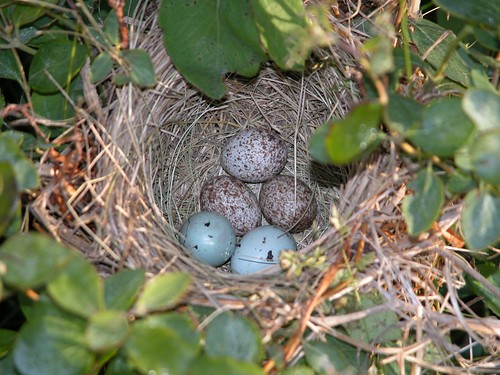

Apparently more than one might think! In a recent Washington Post article, I read about some research done by an avian ecologist at the Illinois Natural History Survey. The researcher, Jeffrey Hoover, noticed that female cowbirds leave their eggs in the nests of other birds. These eggs and, eventually, the hatchlings were taken care of by the “host” birds.
Out of curiosity, the researchers removed some cowbird eggs from the nests of the other birds. Strangely, these nests were subsequently destroyed. Come to find out, the female cowbirds were keeping an eye on the nests where they placed their eggs and, if anything happened to them, they would destroy the nest in retaliation. The “host” birds raised the “foreign” hatchlings because this ensured some of their own chicks would survive – otherwise, “mobster” cowbirds killed all the chicks.
Frans de Waal, a primatologist at Emory University, says that the difference between humans and cowbirds is that the cowbirds aren’t thinking through their nest-trashing strategy. Gangsters like Laurence Fishburne as “Bumpy Johnson” in the movie Hoodlum certainly do: “You've been warned. Get ready for your final thrill. It's curtains, Dutch. The jig is up.”
It’s hard to know whether cowbirds think “the jig is up” before they destroy the nest of another bird or not. Nevertheless, this is an interesting example of how human behavior is not fundamentally different from animal behavior. In fact, De Waal argues that much of human behavior may have been hard-wired into us through evolution. That some behavior is “built-in” helps to explain how certain “intuitive” (and not necessarily effective) behaviors like tit-for-tat are used the world over and influence many aspects of social interaction and perception. If, as some behavioral researchers now think, we’re hard-wired to use intuitive (and potentially inefficient) strategies like tit-for-tat, we need to make an extra effort to get beyond our constraints and pursue more effective ways to interact – something relevant to thinking about negotiating.
Ashley Thornton
References
Vedantam, Shankar. “Behavior May Suggest We’re Not Only Human.” Washington Post, March 19, 2007, via Washington Post online, http://www.washingtonpost.com/.
Photos by Pete Baer show three speckled cowbird eggs in the nest of a red-winged blackbird and the same nest after the blackbird eggs were pushed out. Retrieved from www.flickr.com.
Wednesday, 7 March 2007
You Scratch My Back...
All humans, regardless of culture or other differences, appear to have certain common perspectives (or ‘constraints’) in dealing with the world. One relates to ‘reciprocal altruism’ or ‘you scratch my back, I’ll scratch yours’. It’s an instinctive strategy that lies at the heart of human collective endeavour from the building of the Egyptian pyramids and the atomic bomb to the International Criminal Court. And, it’s the basis for our urge to detect and punish cheats or free riders in our everyday lives.
Tit for Tat. Do unto others. Whatever we call it, mutual reciprocity is an urge with a deep basis in our nature in common with many other species, some as simple as bacteria and viruses. Primate behavioural expert Frans de Waal recently observed, “Humans and other animals share a heritage of economic tendencies – including cooperation, repayment of favours and resentment at being short-changed.”
So what? The key is the ability to discriminate against non-reciprocators by withholding future aid. Let’s consider that. A wide range of scientific evidence reveals Tit for Tat and other intuitive strategies can work great in a two person ‘Prisoners’ Dilemma’ situation. It even works well in a group of other people if we can keep track of their individual intentions, along with our past record of cooperation or defection with them. We have social brains, and they’re nicely adapted for just this kind of social exchange.
But multilateral negotiations are harder. They involve many different actors at the state and individual level. The United Nations has 190 or so member countries. It means hundreds of delegates may be involved in a negotiation (although, obviously, some matter much more, in practice, to the outcome than others). Hundreds – or even thousands – more people may exert influence or issue orders from capitols to their delegates, although invisible to most other negotiators at the seat of the negotiation.
It’s hard for negotiators to keep track of all of these relationships, even just the ones they consider significant. There’s also potential for individual negotiators to confuse reciprocity at the personal level with the broad balance of interests between their governments. This is a line that fades from the fuzzy to the invisible if negotiators aren’t aware that the potential for crossing it exists.
The upshot is that in multilateral negotiating situations, ‘nice but retaliatory’ strategies like Tit or Tat run into difficulty because it’s very difficult to discriminate against non-reciprocators.
John Borrie
